Forest Disturbance Regimes: Wildfire Pyrodiversity, Windthrow Gap Dynamics, and Bark Beetle Outbreak Kinetics

🔥 Disturbance Ecology & Landscape Dynamics Natural disturbances are not ecological catastrophes; they are intrinsic evolutionary drivers that reset successional trajectories, create structural heterogeneity, and generate essential biological legacies across forest landscapes. 1. The Paradigm of Natural Disturbance Regimes in Forest Ecology Modern ecological science views forests not as static, unchanging climax formations, but as … Read more

Canopy Hydrology & Atmospheric Moisture Flux: Interception Storage, Stemflow Chemistry, and Sapflow Dynamics

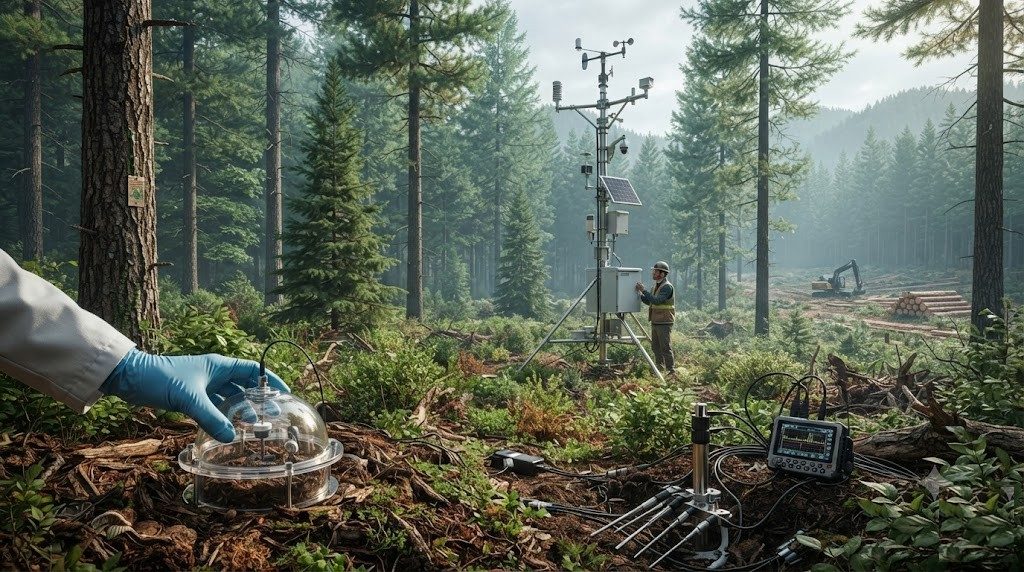
🌧️ Eco-Hydrological Forest Science Canopy hydrology partitions gross rainfall into interception evaporation, throughfall dripping, and concentrated stemflow, directly shaping soil pedology, microbial hotspots, and continental moisture recycling. 1. The Forest Canopy as a Dynamic Hydrological Filter The forest canopy does not act as a simple passive umbrella; it is an active, multi-layered aerodynamic filter that … Read more

Forest Carbon Dynamics & Biogeochemical Cycling: Net Primary Productivity, Eddy Covariance, and Soil Respiration Flux

🌱 Biogeochemical Flux & Carbon Accounting Forest ecosystems represent the engine of the terrestrial carbon cycle, sequestering approximately one-third of global anthropogenic carbon emissions through complex balances of photosynthetic uptake, autotrophic respiration, and subterranean microbial decomposition. 1. The Terrestrial Carbon Balance: Gross vs. Net Primary Productivity Global forests cover approximately four billion hectares, functioning as … Read more

Mycorrhizal Fungal Networks & the Wood Wide Web: Hyphal Carbon Shuttling, Kin Recognition, and Signal Transduction

🍄 Subterranean Ecological Overview The ‘Wood Wide Web’—common mycorrhizal networks (CMNs) connecting individual trees—governs forest community assembly, facilitating subterranean carbon shuttling, defense signaling, and resource redistribution across disparate botanical taxa. 1. The Subterranean Architecture of Common Mycorrhizal Networks (CMNs) Beneath the floor of undisturbed forests lies a continuous, hyper-complex biological infrastructure known as the common … Read more